







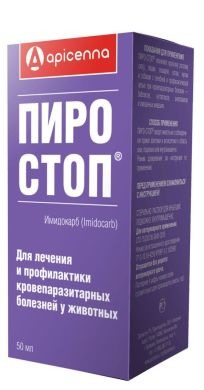


Piro-stop, 50 ml
Composition and form of release
Pyro-Stop is an antiprotozoal injectable preparation containing 120 mg of imidocarb dipropionate in 1 ml of solution as an active ingredient, as well as auxiliary components: 10 mg of polyvinylpyrrolidone, 9 mg of benzyl alcohol, 30 mg of propionic acid and water for injection. The drug is packaged in 10 ml vials, individually packed in a cardboard box.
Pharmacological properties
The active ingredient of the drug belongs to the group of imidazolines and is highly effective against blood parasites: Babesia bovis, Babesia ovis, Babesia bigemina, Babesia colchica, Babesia equi, Babesia divergens, Babesia canis, Babesia caballi, Babesia gibsoni, Francaiella annchulata, Theria seria ser , Theileria mutans, Theileria orientalis, Theileria ovis, Theileria recondita, Theileria tarandirangiferis, Nuttallia equi, Anaplasma marginale, Anaplasma ovis, and Ehrlichia canis. The mechanism of the antiprotozoal action of imidocarb is associated with the suppression of the intake of inositol (a vitamin-like substance), which is necessary for the vital activity of blood parasite, as well as with a violation of the formation and use of polyamines by blood parasites. After parenteral administration of the drug, the therapeutic concentration of imidocarb dipropionate in the blood is reached after 18-24 hours and is maintained at the piroplasmostatic level for 4-6 weeks. Imidocarb dipropionate accumulates mainly in the kidneys and liver, and is excreted from the body mainly in the urine. According to the degree of impact on the body, Piro-Stop belongs to moderately hazardous substances and in the recommended doses does not have a local irritating, embryotoxic and mutagenic effect.
Indications
Prescribed to cattle, sheep, horses, donkeys, mules and dogs for the treatment of blood parasitic diseases (babesiosis, theileriosis, anaplasmosis, nutalliosis, ehrlichiosis and mixed invasions).
Doses and method of administration
Pyro-Stop is administered to animals in compliance with the rules of asepsis and antiseptics in the neck area, subcutaneously or intramuscularly in the following doses as indicated:
| For cattle: | |
| Treatment and prevention of babesiosis | 2 ml per 100 kg of animal weight once |
| Treatment and prevention of anaplasmosis and mixed invasions | 2.5 ml per 100 kg of animal weight once |
| Elimination of the carrier state | 4 ml per 100 kg of animal weight, twice with an interval of 14 days |
| For horses, donkeys and mules: | |
| Treatment and prevention of babesiosis | 2 ml per 100 kg of animal weight once |
| Elimination of the carrier state of Babesia caballi | 2 ml per 100 kg of animal weight, twice with an interval of 24 hours. |
| Elimination of the Babesia equi carrier state | 4 ml per 100 kg of animal weight, four times with an interval of 72 hours. |
| Sheep: | |
| Treatment of babesiosis, anaplasmosis and mixed invasions | 0.2 ml per 10 kg of animal weight, once |
| For dogs: | |
| Treatment and prevention of piroplasmosis | 0.25 – 0.5 ml per 10 kg of animal weight, once |
For prophylactic purposes, Piro-Stop is used when one or two animals in a herd are diagnosed with clinical signs of a disease, when ixodid ticks – carriers of blood parasitic diseases are attacked (or threatened with an attack), and also within a week after the animals have moved to regions unfavorable for these diseases … The drug is administered to cattle once every 6 weeks, to horses, donkeys, mules – once every 4 weeks, to dogs – once a season with the threat of an attack on animals by ixodid ticks (hunting, hiking in a forest, etc.). Dogs must be supervised by a veterinarian for at least 15 minutes after treatment. Along with Piro-Stop, dogs are recommended to use antihistamines in accordance with the instructions for use. For animals with clinical signs of babesiosis, it is also advisable to use antihistamines before drug administration. Due to the possible painful reaction, the drug should not be administered in one place to large animals in a volume exceeding 10 ml, to small animals in a volume exceeding 2.5 ml. With the mass death of blood parasites and the destruction of erythrocytes after the use of Pyro-Stop in animals, intoxication may develop. In this case, it is necessary to carry out intensive therapy, including intravenous administration of electrolyte solutions and hepatoprotectors. Before mass processing, each batch of the drug should be tested on a small group of animals (5-10 animals). In the absence of complications, within 3 days, they begin to process the entire livestock. Due to the possible painful reaction, the drug should not be injected into one place in large animals in a volume exceeding 10 ml, in small animals in a volume exceeding 2.5 ml. With the mass death of blood parasites and the destruction of erythrocytes after the use of Piro-Stop in animals, intoxication may develop. In this case, it is necessary to carry out intensive therapy, including intravenous administration of electrolyte solutions and hepatoprotectors. Before mass processing, each batch of the drug should be tested on a small group of animals (5-10 animals). In the absence of complications, within 3 days, they begin to process the entire livestock. Due to the possible painful reaction, the drug should not be administered in one place to large animals in a volume exceeding 10 ml, to small animals in a volume exceeding 2.5 ml. With the mass death of blood parasites and the destruction of erythrocytes after the use of Pyro-Stop in animals, intoxication may develop. In this case, it is necessary to carry out intensive therapy, including intravenous administration of electrolyte solutions and hepatoprotectors. Before mass processing, each batch of the drug should be tested on a small group of animals (5-10 animals). In the absence of complications, within 3 days, they begin to process the entire livestock. With the mass death of blood parasites and the destruction of erythrocytes after the use of Piro-Stop in animals, intoxication may develop. In this case, it is necessary to carry out intensive therapy, including intravenous administration of electrolyte solutions and hepatoprotectors. Before mass processing, each batch of the drug should be tested on a small group of animals (5-10 animals). In the absence of complications, within 3 days, they begin to process the entire livestock. With the mass death of blood parasites and the destruction of erythrocytes after the use of Piro-Stop in animals, intoxication may develop. In this case, it is necessary to carry out intensive therapy, including intravenous administration of electrolyte solutions and hepatoprotectors. Before mass processing, each batch of the drug should be tested on a small group of animals (5-10 animals). In the absence of complications, within 3 days, they begin to process the entire livestock.
Side effects
In rare cases, a local reaction in the form of hyperemia or painful swelling at the injection site is possible, spontaneously disappearing after 1 to 2 days. With increased individual sensitivity to the drug in animals, bradycardia, increased and impaired breathing, anorexia, profuse salivation and lacrimation, skin hyperhidrosis, muscle tremors, frequent urination and defecation are possible. In these cases, the animal is prescribed subcutaneously 1% solution of atropine sulfate, desensitizing drugs and symptomatic therapy.
Contraindications
Hypersensitivity to the components of the drug. Simultaneous use of Pyro-Stop with organochlorine, organophosphorus drugs and other cholinesterase inhibitors is not allowed. Do not use the drug within 4 weeks after vaccination with live vaccine against babesiosis or anaplasmosis.
special instructions
Slaughter of cattle, horses and sheep for meat is allowed no earlier than 28 days after the last application of Piro-Stop. In case of the forced slaughter of animals before the established date, the meat can be used as feed for fur animals. Milk of dairy cows and mares may be used for food purposes no earlier than 4 days after the last injection of Piro-Stop. The milk obtained earlier than the established period after boiling can be used in animal feed. Milk of lactating sheep treated with Piro-Stop must not be used for food purposes during the entire lactation period. In case of accidental contact of the drug on the skin or mucous membranes, it must be washed off with running water and soap, if ingested, immediately contact a medical institution, having with you instructions for the use of Piro-Stop or a bottle with a label. There are no specific antidotes.
Storage conditions
With precautions according to list B. In a dry, dark place, out of reach of children and animals, at a temperature of 2 to 25 ºС. Shelf life is 2 years. Opened vials with the drug should be stored for no more than 28 days.