







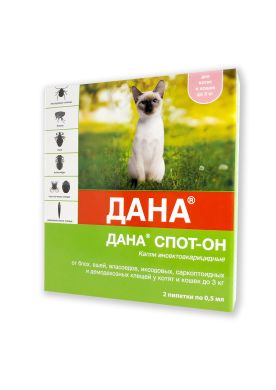


Dana Spot-On drops for kittens, 3 x 0.5 ml
Composition and form of release
Dana is an insect-acaricidal agent in the form of a solution for external use (International non-proprietary name of the drug: fipronil).
Dana Spot-on contains in 1 ml fipronil – 50 mg and auxiliary substances: isopropyl alcohol – 300 mg, dimethylformamide – 100 mg, citric acid – 1 mg and polyethylene glycol – up to 1 ml. In appearance, the drug is a clear oily liquid with a weak specific odor for external use. The drug is produced in 1 ml plastic tube-pipettes.
Pharmacological properties
Dana Spot-on belongs to insectoacaricidal drugs of the phenylpyrozole group.
Fipronil, which is part of the drug, has a pronounced insectoacaricidal activity against preimaginal and imaginal phases of development of fleas (Stenocephalides canis, Stenocephalides felis) lice (Linognatus setotus), lice (Trichodectes canis), sarcoptes vulpis ( Otodectes cynotis, Psoroptes cuniculi), ixodid ticks (Ixodes ricinus, Rhipicephalus sanguineus, Dermacentor reticulatus, Ixodes scapularis, Dermacentor variabilis) and Demodex canis ticks.
The mechanism of action of fipronil is to block the GABA-dependent receptors of arthropods, disrupt the transmission of nerve impulses, which leads to paralysis and death of insects and ticks.
After applying the drug to the skin, fipronil, practically not absorbed into the systemic circulation, spreads along the skin and hair of the animal, accumulates in the epidermis, hair follicles and sebaceous glands, providing a contact insectoacaricidal effect, which manifests itself after 12-24 hours and lasts for 4- 6 weeks after a single treatment of the animal.
Dana Spot-on, according to the degree of impact on the body, belongs to low-hazard substances, in the recommended doses it does not have a skin-irritating, skin-resorptive and sensitizing effect, when it gets into the eyes it causes slight irritation. The drug is toxic to rabbits, bees, as well as fish and other aquatic organisms.
Indications
Assigned to dogs and cats from 12 weeks of age for the treatment and prevention of entomoses caused by fleas, lice and lice, acarosis caused by sarcoptoid, ixodic and demodectic mites, fur animals – for the treatment and prevention of otodectosis.
Doses and method of administration
Dana Spot-on for the treatment and prevention of entomoses, as well as for the protection of dogs and cats from the attack of ixodid ticks is used once by drip application (“spot-on”) on dry intact skin in places inaccessible for licking by animals (the area of the back between the shoulder blades or the neck area at the base of the skull), choosing a pipette tube of the required volume, taking into account the type and weight of the treated animal, in the doses indicated in the table:
| Animal weight, kg | The dose per animal of the drug ml. (number of pipettes) |
| Dogs | |
| Up to 10 kg
10 – 20 20 – 40 More than 40 kg |
1.5 ml. (1 pipette 1.5 ml) / 45 drops
3 ml. (3 pipettes 1 ml *) 4.5 ml. (3 pipettes 1.5 ml *) 6 ml. (4 pipettes 1.5 ml *) |
| Cats | |
| thirteen | 1 pipette 0.5 ml. |
| More than 3 kg | 1 pipette * 1 ml. |
*) or a combination of pipettes of other volumes.
Repeated treatments of animals during the season of the greatest activity of parasites are carried out according to indications, but not more often than once a month, with frequent washing of the animal with a detergent (more than 2 times a month) – not more than 1 time in 2 weeks.
In order to prevent re-infestation by fleas, animals are replaced by bedding or treated with an approved insecticidal preparation in accordance with the instructions for use.
The acaricidal effect of fipronil begins 24 hours after the application of the drug, in this regard, the treatments should be carried out no later than a day before the intended walking of the animal in areas of possible habitation of ticks (parks, squares, forests).
To destroy ixodid ticks on the body of the animal, the drug in the amount of 1-2 drops is applied to the tick and the place of its attachment to the skin. If the tick does not fall off spontaneously within 20-30 minutes, it is carefully pulled out of the body and destroyed.
For the treatment of dogs, cats and fur-bearing animals with otodectosis (ear scabies), the external auditory canal is cleaned of scabs and crusts, then 3-5 drops of the drug are instilled into each ear, the auricle is folded in half lengthwise and its base is massaged. The treatment is repeated 2-3 times with an interval of 5-7 days. If necessary, repeat the course of treatment.
The drug must be injected into both ears, even if clinical signs of the disease are detected in only one ear.
When dogs and cats are affected by sarcoptic mange, notoedrosis or demodicosis, the drug is applied in a thin layer to the affected areas of the body previously cleaned of scabs with a swab from the periphery to the center with the capture of borderline healthy skin up to 1 cm, in doses indicated in the table.
In a severe course of the disease, it is recommended to treat the animal in a complex manner using pathogenetic and symptomatic drugs. The treatment is carried out 3-5 times with an interval of 7-10 days until the animal’s clinical recovery, which is confirmed by two negative results of acarological studies.
Animals with extensive lesions are treated in two doses with an interval of 1 day, applying the drug first to one and then to the other half of the affected body surface.
To prevent licking of the drug, animals wear a neck collar, muzzle or close their jaws with a loop of braid, which are removed 20-30 minutes after applying the drug.
Do not apply the drug to damp and / or damaged skin, bathe the animal in open water, or wash it with a detergent within 48 hours after treatment.
Side effects
In rare cases, with increased individual sensitivity to the drug and an overdose in animals, profuse salivation, vomiting, muscle tremors and skin irritation may appear. In these cases, the use of the drug is discontinued, its remnants are carefully removed with a cotton-gauze swab, the wool is thoroughly washed with soap and water or shampoo. If necessary, the animals are prescribed desensitizing and symptomatic therapy.
Contraindications
Contraindication to use is an individual intolerance to the components of the drug, including a history. Patients with infectious diseases and recovering animals, dogs weighing less than 2 kg, kittens and puppies under 12 weeks of age are not subject to treatment. Auricular use of the drug (for ear scabies) is not allowed when the tympanic membrane is perforated. For pregnant and lactating females, Dana Spot-on is used, if necessary, under the supervision of a veterinarian.
special instructions
The peculiarities of the action of the drug during its first use and withdrawal were not revealed.
Violations of the drug use regimen should be avoided, as this can lead to a decrease in its effectiveness. If the next treatment is missed, it should be carried out as soon as possible, in the same dose.
When using the drug in accordance with this instruction, side effects and complications in animals, as a rule, are not observed. In some animals, with individual hypersensitivity and the appearance of signs of skin irritation and allergic reactions, the drug should be washed off with water and detergent and, if necessary, desensitizing therapy should be carried out.
Dana Spot-on should not be used in conjunction with other insectoacaricidal drugs for treating animals.
The drug is not intended for the treatment of productive animals.
Personal prevention measures
When handling the drug, rubber gloves should be used, especially if there are abrasions and other skin lesions on the hands. Do not drink, smoke or eat during processing. You should not pet the animal and keep it away from small children within 24 hours after using the drug. If the product gets on the skin or mucous membranes, it must be immediately washed off with a stream of water or removed with a swab and then washed with water. At the end of the treatment, hands should be thoroughly washed with warm water and soap.
Storage conditions
With caution. Store in a dry, dark place and out of reach of children and animals, separately from food and feed at a temperature of 2 ° C to 25 ° C. Shelf life – 2 years from the date of production.