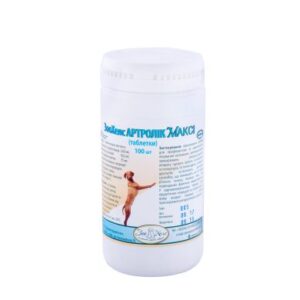







Artrolic Maxi “ZooHels”, 100 tab.
Description
Flat cylindrical scored tablets without a coating, cream color with brownish blotches with a specific odor. Zoohels Artrolic is produced in two modifications:
Zoohels ARTROLIC (for small breeds of dogs and cats, tablets of 0.5 g) and Zoohels Artrolic maxi (for medium and large breeds of dogs, tablets of 2 g).
Structure
1 g of tablet mass contains:
glucosamine hydrochloride – 250 mg,
chondroitin sulfate – 102 mg,
methylsulfonylmethane – 75 mg.
Excipients: micro cellulose, polyvinylpyrrolidone, brewer’s yeast, talc, manganese sulfate, calcium stearate, vitamin C.
Pharmacological properties
Zoohels Artrolic is a complex of biologically active substances: glucosamine hydrochloride, chondroitin sulfate, and methylsulfonylmethane, which are in an easily assimilated and accessible form for the body. Glucosamine and chondroitin sulfate, as natural components of connective tissue, have anti-inflammatory, desensitizing, and chondroprotective effects on the osteochondral system of the joint. An additional intake of chondroitin and glucosamine is especially necessary for animals during the recovery period after injuries and surgical interventions, during heavy physical exertion in service and sports dogs. In dogs experiencing systematic stress on the joints, especially with age, there is a decrease in the amount of joint fluid, a decrease in the elasticity of the ligamentous apparatus, and degenerative processes in the cartilage.
Glucosamine and chondroitin sulfate reduce the severity and intensity of manifestation of degenerative changes in the joint, reduce the likelihood of developing diseases of the musculoskeletal system of the animal. Glucosamine increases the content of glucosaminoglycans in the joint, which in turn are the building blocks for cartilage repair. Glucosamine stimulates collagen synthesis, has an antioxidant effect, inhibits the activity of lysosomal enzymes (which destroy cartilage), reduces the manifestations of adverse reactions to chemotherapeutic agents for animal protection when used in a complex of therapeutic and prophylactic measures together with non-steroidal and steroidal anti-inflammatory drugs. Stimulates the regeneration of cartilage tissue. Glucosamine and chondroitin sulfate are involved in the synthesis of connective tissue, helping to prevent the processes of cartilage destruction and stimulating tissue regeneration.
The introduction of exogenous glucosamine enhances the production of cartilage matrix and provides nonspecific protection against chemical damage to the cartilage. Glucosamine in the form of sulfuric salt is a precursor of hexosamine, and the sulfate anion is required for the synthesis of glycosaminoglycans. Another possible function of glucosamine is to protect damaged cartilage from metabolic destruction caused by NSAIDs and GCS, as well as its own moderate anti-inflammatory effect.
Chondroitin sulfate, regardless of whether it is absorbed intact or as separate components, serves as an additional substrate for the formation of a healthy cartilage matrix. Stimulates the formation of hyaluronan, the synthesis of proteoglycans and collagen type II, and also protects hyaluronic from enzymatic degradation (by suppressing the activity of hyaluronidase) and from the damaging effects of free radicals; maintains the viscosity of the synovial fluid, stimulates the mechanisms of cartilage repair and suppresses the activity of those enzymes that break down cartilage (elastase, hyaluronidase). In the treatment of osteoarthritis, relieves the symptoms of the disease and reduces the need for NSAIDs.
The oral bioavailability of glucosamine is 25% (“first pass” effect through the liver). The highest concentrations are found in the liver, kidneys, and articular cartilage. About 30% of the dose taken persists for a long time in bone and muscle tissue. It is excreted mainly in the urine unchanged; partly with feces. T1 / 2 – 68 hours. Chondroitin sulfate: when taken orally, the plasma concentration increases sharply within 24 hours. Bioavailability – 12%. About 10 and 20% of the dose taken is absorbed in the form of high molecular weight and low molecular weight derivatives, respectively. The volume of distribution is about 0.44 mg/ml. Metabolized by desulfurization. It is excreted in the urine. T1 / 2 – 310 min.
Methylsulfonylmethane (organic sulfur, MSM) is a source of sulfur, provides the molecular structure of the protein, is part of many amino acids, and participates in the synthesis of antioxidants, in particular glutathione. Sulfur is essential for joint tissues, where it is responsible for the stability of cartilage tissues, capsules, and ligaments. MSM has a positive effect on joint pain, helps to restore joint mobility, as well as improves the permeability of cell walls, and allows fluid and substances dissolved in it to more easily penetrate the cell membranes. This facilitates the elimination of substances such as lactic acid and toxins from the cells, and the entry of nutrients and trace elements into the cells. MSM prevents an increase in intracellular pressure, relieves pain.
Vitamin C, has anti-inflammatory and anti-edema properties, promotes the activation of collagen formation in bone, cartilage, and vascular tissues inhibit the destruction of joints due to its antioxidant effect.
Manganese is an essential element that acts on the growth and development of connective tissues. It is essential for the synthesis of glucosamine. With manganese deficiency, the synthesis of cartilage and synovial fluid slows down. Its antioxidant effect has also been proven.
Brewer’s yeast is a source of natural proteins and vitamins, and an effective therapeutic and prophylactic agent. Brewer’s yeast contains carbohydrates; fourteen vitamins: all B vitamins (choline, thiamine, pyridoxine, pantothenic acid, and folic acid) and vitamins E, PP, H, provitamin D, and others; essential fatty acids, enzymes: β-fructofuranosidase, glucosidase, peptidase, proteinase; a large number of minerals: calcium, magnesium, manganese, zinc, iron, phosphorus, selenium and others.
Zoohels Artrolik, according to the degree of impact on the body of warm-blooded animals, belongs to low-hazard substances and in recommended doses does not have a local irritant and sensitizing effect.
Application
Prescribed to dogs and cats for the prevention and complex treatment of inflammatory and degenerative diseases of the musculoskeletal system (arthritis, arthrosis, osteoarthritis, osteoarthritis, osteochondrosis, osteochondropathy, osteoporosis, dysplasia of the joints) that occur against the background of injuries of various origins, age-related changes, with increased physical exertion … In the recovery period after surgical operations on the musculoskeletal system of an animal in order to accelerate reparative processes.
Dosage
Zoohels Artrolic is fed directly from the hand, or crushed with feed. It is recommended to divide the daily dose into 2-3 doses.
| Appointment
(Disease) |
DoZooHels ARTROLIK
(tablets of 0.5 g) |
ZooHels ARTROLIC MAXI
(tablets 2 g) |
| Dogs | ||
| For prevention: young, growing animals | 1 tab. per 10 kg body weight | 0.5 tab. per 20 kg body weight |
| For intensive restoration of cartilage and joints in highly stressed dogs | 2 tab. per 10 kg body weight | 1 tab. per 20 kg body weight |
| For hip dysplasia or joint inflammation | 3 tab. per 10 kg body weight | 1.5 tab. per 20 kg body weight |
| Cats | ||
| For prevention: young animals, kittens during the growth period | 1 tab. per 3 kg of body weight | – |
| For intensive joint regeneration, for aging cats | 2 tab. per 3 kg of body weight | – |
Zoohels Artrolic should be used for at least 6-8 weeks; for prophylactic purposes, it is recommended to repeat the application with an interval of 3 months. Permanent use is possible.
The use of Zoohels ARTROLIC does not exclude the appointment of chemotherapeutic agents for the protection of animals, vitamin and mineral complexes, and additives.
Side effect
In rare cases, allergic reactions may occur in some animals that are sensitive to the components of the feed additive. In this case, the use of the drug is discontinued.
Contraindications
Hypersensitivity of animals to the components of the drug, severe violations of the liver and kidneys.
Release form
Jars of polymeric materials of 100 tablets (2 g tablets) and 120 tablets (0.5 g tablets).
Storage
In a dry, dark place, out of the reach of children and animals. Separated from food and feed in manufacturer’s packaging at temperatures from 0 to 25 ° C.
Shelf life is 2 years.